
About
Hi, my name is Djordje. I’m an iconographer and artist based in Auckland, New Zealand, and it is my aspiration to further the field of Byzantine iconography in Oceania.

I mostly grew up in New Zealand, but I was born in Serbia and also spent my formative years living with my family in Yorkshire, UK. During this time, I was lucky enough to visit many churches and monasteries in the Balkans, where there are some of the most beautiful icons and frescoes to be found, all of which made such an impression on me. And so my love of Byzantine iconography, frescoes and architecture stems from my childhood, and has stayed with me ever since.
Due to our background, we have the tradition of the Slava, a celebration dedicated to our family’s patron saint. Regardless of where we lived, however, our icons and traditions travelled with us. After so much travelling and moving about, it has become increasingly clear how important this tradition, the presence of our patron saints and that of Christ and the Theotokos in our home, has been to the preservation of my own identity and link to my heritage.
It is therefore my joy and honour to be able to participate in the creation of icons with God’s help, and to work towards advocating for the growth of this tradition in Oceania.
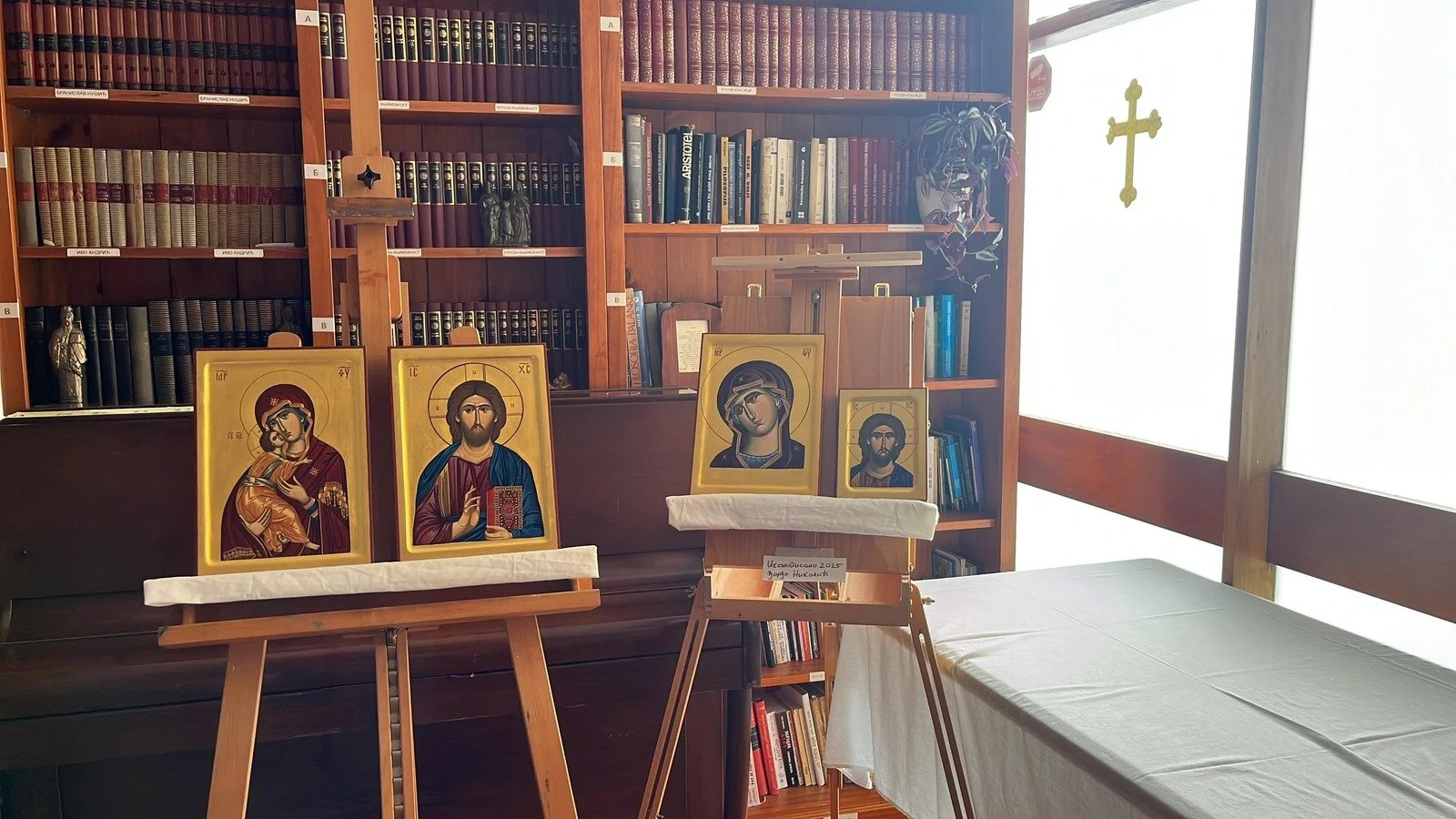
My process
I’m happy to discuss my process with anyone who is interested.
01
Preparing the board
I start with a pencil sketch, or study, which I transfer to a limewood board that has been prepared by layering traditional rabbit skin glue gesso over the board. The gesso is then sanded to a stone-smooth finish.
02
Gilding
The areas of gilding are then prepared, either with red Armenian bole for water gilding, or with finely sanded shellac for oil gilding. Once the gold leaf is applied, it is varnished to protect it from any handling and veneration.
03
Drawing in egg tempera
I then use my transferred sketch to begin the icon. Usually this drawing is done with black egg tempera paint and establishes the main form and proportions, and begins the painting process.
04
Layers of light
Colours are then applied, generally working from dark to light. The proplasmos, or shadow tone, initially placed under any skin tones, is described as the uncreated matter. The layers of skin tones that follow are described as layers of light: the process of creation, and matter coming together into the final form.
05
Varnishing
After the painting is complete, the icon needs to dry properly before it is varnished. I typically use traditional varnishes such as olifa, dammar, shellac or punic wax, or a combination of these, to achieve the desired finish. I prefer to avoid using synthetic materials in order to keep the icon as natural as possible.
Get in touch
Email: Dnicons@gmail.com
Based in Auckland, New Zealand. Shipping to New Zealand and Australia.